David, Meet Goliath

The state approved National Grid’s bid to expand fracked gas, but also ordered it to engage with its staunchest opponent: Greenpoint’s community board.

By JACK DELANEY | jdelaney@queensledger.com

WILLIAMSBURG — The two groups shuffled in from the cold, unzipping their coats as they settled uneasily into opposite sides of the room.

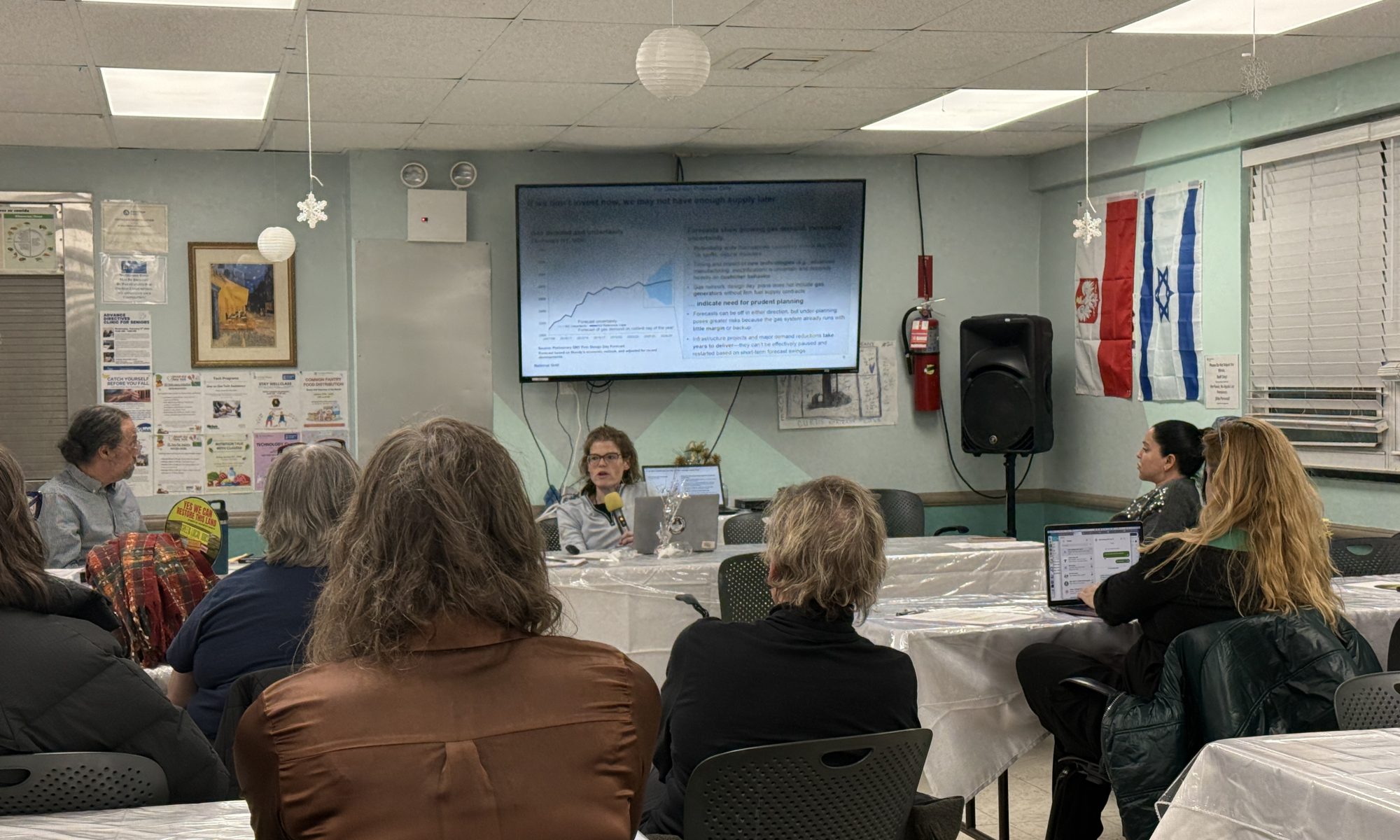
On Thursday, January 15, representatives for National Grid — which provides energy to nearly 2 million customers in the New York metro area — met with Brooklyn Community Board 1 (CB1) at Swinging Sixties Older Adult Center, the first in-person forum since the state approved the company’s request to expand its fracked gas infrastructure last fall.

But this wasn’t a victory lap. While the approval of its “Long-Term Plan” was a major coup for National Grid, the regulator’s decision included some caveats. First, it noted that a new pipeline project running from New Jersey to the Rockaways, known as NESE, could eventually render National Grid’s 120-acre gas depot along Newtown Creek unnecessary, a boost to locals who have been calling for it to be decommissioned for decades.

Second, the ruling ordered National Grid to engage with CB1 and “take part in its meetings,” as a way for the fossil fuel giant to “hear the community’s concerns and attempt to address [them].”

The exact parameters or duration of that engagement are uncertain, but the upshot on Thursday was clear: National Grid’s emissaries would have to answer questions from residents who have spent thousands of hours trying to shut down its primary foothold in North Brooklyn.

The meeting began with a presentation by MaryBeth Carroll, director of gas scenario planning for National Grid and a lead architect of its Long-Term Plan, who foregrounded the discussion with an overview of the company’s operations throughout New York City. Nearly all of its fracked gas is sourced from the Marcellus Shale in Northern Pennsylvania, she explained, before being carried by pipelines to two storage facilities — one in Holtsville, Long Island, and the other in Greenpoint.

Do you all acknowledge that Greenpoint residents don’t want this LNG storage in the neighborhood?”

The audience, exclusively composed of local environmental advocates, wasted no time in interrogating Carroll’s high-level summary. One bone of contention during the two-year legal battle over the Long Term Plan was whether the quantity of natural gas stored inside the Greenpoint Energy Center made sense. National Grid claimed that the hulking tanks were a fallback in case the demand for gas spiked far above supply amid an extremely cold spell. But an independent consultant found that those reserves were almost never used — and as one attendee noted, the corporation’s forecasts are based on a hypothetical “design day” in which the average temperature drops to 0º Fahrenheit, something that has not happened in NYC since 1934.

“It has not gotten within 10 degrees of that in the last 15 years,” noted a member of Sane Energy Project, a Greenpoint-based advocacy group that was out in force for the CB1 meeting. “If there’s evidence to show that it should be raised, are you currently working to raise it? Because clearly this is not appropriate design day, and that’s costing all of us who pay bills here a lot of money.”

The presentation next turned to safety protocols. “We want to make sure that everybody who is a customer stays safe, that everybody who is living in the communities around our customers stays safe, and that our employees stay safe,” said Carroll. “It’s just something that we are uncompromising on.”

But the Greenpointers in the crowd shot back with several pointed questions. Kim Fraczek, director of Sane Energy Project, brought up an explosion at the nearby gas depot in 2022 that knocked a worker unconscious, asking why the community board was never informed. (“I’m aware of that incident,” replied Carroll, promising to loop in CB1’s Steve Chesler in the future. “I don’t know the details.”)

Next, Laura Hoffman inquired about the extent of soil pollution at both the depot site and an adjacent Little League field that was opened by National Grid in 1999 as a gift to the community before being closed in 2022 as revelations of contamination came to light. “To my knowledge, the lead that was on the property from previous demolitions was never cleaned up, which was part of the reason why the kids were no longer allowed to use the ball field,” she said. “My grandson was one of the kids that played there. Since you’re talking about the commitment to safety, I want to hear about that.”

Another prominent topic was National Grid’s initiatives to promote non-pipeline alternatives (NPA), a range of measures — such as heat pumps, improved insulation, and managing demand — that limit the need for companies to build more gas infrastructure. Residents noted that National Grid refers many customers to Con Edison’s program rather than investing in one of its own.

“We would be very interested to work with you on that. If you’re considering doing pipe replacements, you can work together with us from the community to organize blocks to do that,” said Fraczek. “The last time you had a community engagement person come to CB1, he told me and a few others that the only thing he does with his job is tell people when to move their cars. I wonder if there could be a better partnership.”

“We’re happy to do it,” said Carroll. “We want to deliver on these things, we just need willing customers.”

The final word, before the National Grid contingent ceded the floor to a representative of an organization working to abolish microplastics, went to fourth-generation local Kevin LaCherra, who refocused the conversation on the Greenpoint Energy Center.

“This community does not want this facility here. It is on some of the most polluted land in North America. It’s 120 acres — you could fit every park in the neighborhood on that facility,” he said. “We’re asked to subsidize it; we’re asked to live next to it. So I do think, with all of this, what I really want to know is do you all acknowledge that Greenpoint residents don’t want this LNG storage in the neighborhood?”

“What I am most interested in going forward is how your planning, as you come back here, is going to reflect what we as residents are asking for,” added LaCherra. “That needs to be a part of this going forward — otherwise, it’s a lot of fancy slides.”
A (Christmas) Tree Grows in Brooklyn

By Geoffrey Cobb

Author, “Greenpoint Brooklyn’s Forgotten Past”

gcobb91839@Aol.com 

Right after Thanksgiving in Greenpoint and Williamsburg every year, the sidewalks are suddenly transformed. Hundreds of cut Christmas trees magically appear, just like mushrooms in a forest after a heavy rain. Though the trees are plentiful, they are not cheap. Tiny trees will run you $50, while a premium tree can cost up to $300! Even though the prices are high, we always buy a tree and drag it home. Decorating the tree brings back happy memories of childhood long ago and the scent that fills the house is heavenly. Please don’t remind me about the pain of cleaning the ubiquitous needles and dragging the tree out of the house at the end of the holiday!

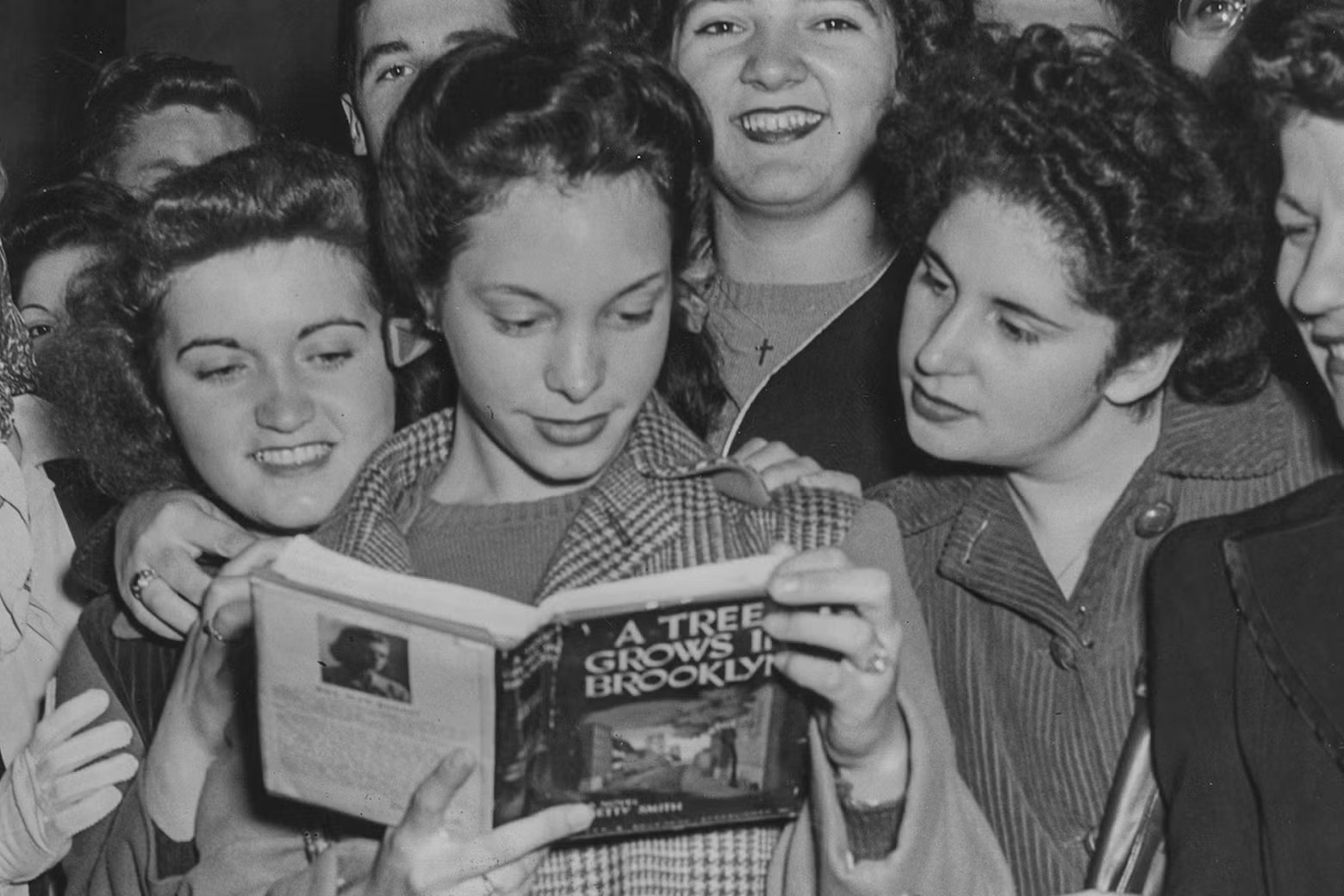
Seeing the trees for sale waiting on snowy local sidewalks reminds me of one of the most touching chapters in the best book ever written about Brooklyn, the 1943 classic, A Tree Grows in Brooklyn. The novel is a coming-of-age story of a young local girl, Francie Nolan who grows up in the poverty of Williamsburg tenements in 1912. The novel was a huge success, and it transformed its author Betty Smith into a famous author overnight. Twentieth Century Fox acquired the rights to the book and two years later it became a box office hit that won a special Oscar award. 

Smith’s chapter about Christmas in our area long ago is one of the most poignant. Francie, the protagonist and narrator, paints a vivid picture of how the struggling local population experienced Christmas long ago. Christmas trees, sadly, were a luxury many could not afford. Ten-year-old Francie excitedly tells her readers, “Christmas was a charmed time in Brooklyn.”  Though they were a charmed time for local children, they were also times of great cruelty as one local ritual the narrator vividly describes proves.

Over a century ago, local sidewalks were also transformed by a salesman hawking Christmas trees. Smith tells us that spruce trees began coming into the neighborhood a week before Christmas. She relates in her novel, “There was a cruel custom in the neighborhood. It was about the trees still unsold at midnight of Christmas eve. There was a saying that if you waited until then you wouldn’t have to buy a tree, that they’d chuck ’em at you.” This was literally true. 

The kids in the area gathered where there were unsold trees. The man threw each tree in turn, starting with the biggest. Kids volunteered to stand up against the biggest. If a boy did not fall under the impact of the tree, it was his. 

The impoverished protagonist, Francie, age ten, and her brother Neely, age nine, volunteered to catch a tree, the biggest in the neighborhood at ten feet. The tree was so large and so expensive that it remained unsold in this area of poor people. Tiny Francie and her brother stepped up to catch the huge tree, much to the delight of the snickering residents who had gathered to watch and enjoy the cruel spectacle. The tree seller admired the bravery of the little duo and thought about just giving them the tree, but rationalized that if he gave them the tree, it would encourage people the following year to wait until midnight and not buy the trees, hurting his business.  The tree salesman finally hurled the ten-foot spruce at the tiny pair and though their legs quivered, they did not buckle under the weight of the tree, and it was theirs, though being hit with the heavy spruce had left them both bruised and bloodied. 

The tree salesman finished the cruel ritual by telling the battered kids,” And now get the hell out of here with your tree you lousy bastards.” 

The children then eagerly dragged the large tree back to their apartment to decorate it. The readers share in the Christmas joy of the poor children who have paid such a steep price for this symbol of Christmas.   The scene re-enforces the theme of the book that poverty was hard in Williamsburg, but it made the kids who suffered through it even harder. 

Thankfully, over a century later our area is far richer. Thousands of locals can afford even high-priced trees, and no child is reduced to the bloody spectacle of catching an unsold Christmas tree, a fact that we can all celebrate this Christmas season. 


One Hour with Zohran Mamdani

By JACK DELANEY | jdelaney@queensledger.com

In the wake of Zohran Mamdani’s win in the Democratic mayoral primary this week, we’re reposting the Star’s roundtable with him from March. While many then considered him a long shot, all of the components  — the catchy (albeit ambitious) platform, social media savvy, and relentlessly optimistic vision for the city — were already on display during our wide-ranging conversation. Read on for insight into how the state rep approached his campaign, and what the past suggests about his ability to make his viral ideas a reality. (Plus: miscellanea about his early love of journalism, cricket skills, and a 2017 race “that changed my life.”)

If state Assemblyman Zohran Mamdani becomes mayor this November, the decisive moment may have come years earlier, over a meal at King of Falafel in 2021.

But first, some context. Growing up, Mamdani had friends whose dads were living through a “crisis that everyone seemed to understand, but no one did anything about.” They were New York taxi drivers, and by the mid-2000s three forces had conspired to burden them with enormous debts: first, the Bloomberg administration inflated the price of medallions, from $200,000 in 2002 to upwards of $1,000,000 in 2014, to generate more revenue.

Soon after, a flood of competition from Uber and Lyft diluted the medallions’ value even as their cost rose. To cap it all off, predatory lenders who had been barred from the housing market swooped in to offer cabbies, 94% of whom are immigrants, loans that would entrap them even further. By 2021, the average driver was $550,000 in the red, and suicide rates had skyrocketed. “I’m going to be enslaved for the rest of my life,” NBC quoted one medallion owner as saying. “[It’s] not only that I will never be able to pay it off — my kids will never be able to pay it off.”

If you lived in Astoria or Long Island City in 2020, you probably received a mailer from Mamdani with a bold promise: if elected to the state assembly, he would cancel excessive taxi medallion debt. It was the sort of splashy proposal that politicians often bandy about, and it worked — his campaign was successful. So a year later, when Mayor Bill de Blasio put forward a plan to earmark $500 million for debt relief, it could have been a victory lap, a box checked.

Instead, Mamdani pressed de Blasio on the details, and began meeting with the taxi drivers’ union, NYTWA, which said the mayor’s proposal was mostly cosmetic. These conversations culminated in 45 days of consecutive protests outside City Hall, at which Mamdani was arrested for civil disobedience, followed by a joint 15-day hunger strike with five other lawmakers that forced the city, against all odds, to accept the taxi drivers’ demands. Though problems with lenders remain, some 2,000 drivers have seen their debts reduced to $200,000 through the resulting deal.

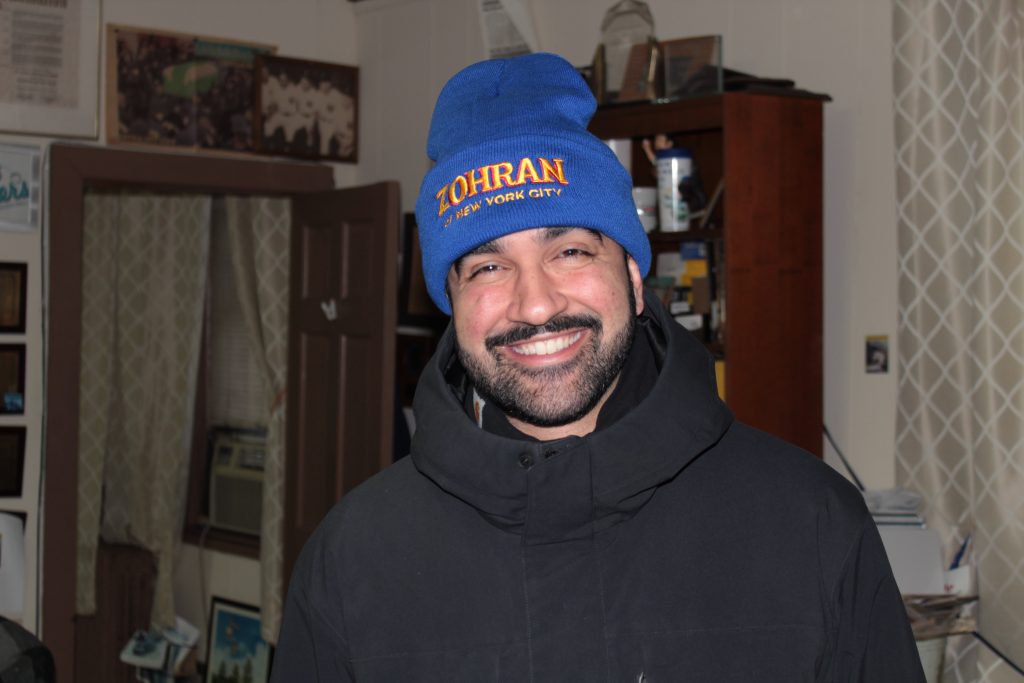
Mamdani shows off some new merch during his visit to the Star’s newsroom.

During the Star’s recent roundtable with Mamdani, he was quick to critique former Governor Andrew Cuomo, the current mayoral frontrunner, saying that “[his] early strength in polls is more a reflection of the mythology of [Cuomo], of nostalgia for his press conferences, than of an actual inspection of his record.” But politics is as much about myths as it is policy, and Mamdani’s fight against medallion debt is one such myth — a story that he will likely tell and retell in the lead-up to the election. The drama of the hunger strike captures his broad pitch to voters, which is that he, unlike both Cuomo and Mayor Eric Adams, is in tune with the struggles of working class New Yorkers and willing to put himself on the line for them.

But just as instructive as the dramatic finale is a quieter episode — after Mamdani questioned de Blasio and before the protests began — when he met Senator Chuck Schumer for lunch at Astoria’s King of Falafel. Once they’d finished eating, Mamdani asked Schumer if he’d take a ride with a cabbie named Richard Chow whose brother, a driver laden with debt, had died of suicide, and who himself had hundreds of thousands of dollars to pay off from loans he took to buy his medallion. Schumer agreed. Based on that experience, Mamdani said, the senator joined the push for debt relief and bartered with the mayor’s office, a major factor in the eventual deal.

“There’s a sadness in knowing that every time you finish a case, there will be another case and a different name, a different person, different specifics.”on his time as a foreclosure counselor.

Four years later, much has changed. Mamdani, whose association with the smaller Democratic Socialists of America (DSA) party has isolated him in Albany, has ridden similarly attention-grabbing promises on social media — free buses, frozen rents, city-owned grocery stores — to go from an upset candidate for mayor to second in the polls, chasing only Cuomo. Last fall, fellow socialists including Assemblywoman Emily Gallagher were saying that his campaign “could be ruinous,” playing spoiler to other progressives with a more realistic shot; now even the New York Post, leery of the DSA, considers him “a serious contender.”

Mamdani, 33, grew up in both Uganda and South Africa before moving to New York at age seven, when his father accepted a teaching job at Columbia University. He went to middle school in Morningside Heights, right by the university, and attended Bronx High School of Science, where he fell in love with journalism. He was also passionate about sports: he captained the soccer team, and co-founded Bronx Science’s cricket team. (To this day, Mamdani is an ardent fan of the soccer team Arsenal — his uncle inducted him into the ranks when he was eight, and he’s been a supporter ever since. His current favorite player is Martin Odegaard, whom he calls the “conductor of the team,” while his childhood pick was Thierry Henry.)

After majoring in Africana Studies at Bowdoin College, Mamdani cut his teeth as an organizer for Change Corps, a precursor to NYPIRG that billed itself as a “training ground for activists.” He ran phone banks for vulnerable senate Democrats out of Seattle, Houston, and lastly Denver, where he tried to unionize with fellow organizers before leaving amid mass firings that ensued. Following a stint in the music and film industries — including a single called “Nani,”released under the pseudonym “Mr. Cardamom,” that received a New York Times write-up— Mamdani knocked on doors for city council candidate Ali Najmi in 2015, and started to “to get a sense of [his] place in the world of local politics.” Yet it was the next race he worked on, a 2017 city council bid by Lutheran minister Khader El-Yateem in South Brooklyn, that set him on his current path.

“That was the campaign that changed my life,” said Mamdani. “I always knew I was a New Yorker. [But] I didn’t know how my politics fit into New York City, and here was this Palestinian man who was vocal in his support for universal human rights, and tying it also to the fight for a more affordable city for working class people, fighting back against corporate interests.”

Mamdani briefly left politics in 2018, to work as a foreclosure-prevention counselor in Jackson Heights and Richmond Hill. The ever-present issue while canvassing had been housing, and this job seemed like a way to tackle those problems directly. “There’s a sadness in knowing that every time you finish a case, there will be another case and a different name, a different person, different specifics,” recalled Mamdani. Still, he was proud that as the only counselor at his organization who spoke Hindi and Urdu, he was able to reach people who weren’t aware that a lien was about to be placed on their home, and help them negotiate with lenders.

At the roundtable, Mamdani repeatedly said that “politics shouldn’t require translation,” a soundbite he’s returned to throughout the nascent mayoral race. The assemblyman’s experience as a housing counselor helps explain why that principle is meaningful to him — and his current campaign’s heavy focus on social media, racking up about 7 million views to date across all platforms, can be seen as an extension of that ethic.

Mamdani donned a thrifted suit for an early video at the Polar Bear Plunge in Coney Island. His campaign has combined an impactful ground game powered by thousands of volunteers with an equally strong social media presence.

“No matter your age, everyone lives on their phone. And it’s an opportunity to tell your story as to what it is you’re fighting for,” said Mamdani, “[even] if that means jumping into ice cold water in a suit bought from Steinway Thrift — $30, incredible deal, I recommend it to all — to speak about a rent freeze.”

Roughly seven months out from the elections, the strategy is already paying off. Mamdani has raised $3.8 million in the last filing period, more than any other campaign, through contributions from more donors than every other candidate combined. His nearly 5000 volunteers have knocked on 60,000 doors, and the barrage of short-form videos about his proposed policies has pulled him neck-and-neck with other, more established contenders like Comptroller Brad Lander.

“I always knew I was a New Yorker. [But] I didn’t know how my politics fit into New York City, and here was this Palestinian man who was vocal in his support for universal human rights, and tying it also to the fight for a more affordable city for working class people, fighting back against corporate interests.” – on working for city council candidate Khader El-Yateem in 2017.

The several-hundred-million dollar question — in some cases billion — is how Mamdani would pay for these blockbuster initiatives if elected. One of his trademark proposals is to abolish the fare for MTA buses, which he said will not only relieve financial pressure from low-income commuters, but also reduce crime and speed up routes by allowing for all-door boarding. Data from a multi-borough pilot program last year largely buttressed these claims. The only catch? He estimates that it would cost the city about $650 million per year to forego bus fares.

Mamdani’s critics say that, as with other socialists, his ideas require spending that’s not feasible. In an interview on The Point in December, Marcia Kramer appeared skeptical that his schemes for drumming up funds, which could include collecting back payments from landlords, would be enough to foot the bill. But the medallion debt deal was a tough sell, costing the city $100 million. And though easy to gloss over, Mamdani’s well-timed alliance with Schumer suggests that the Queens assemblyman may have a more pragmatic bent than his catchy, rapid-fire TikToks might convey.

Every candidate, from the progressive state Senator Zellnor Myrie to the centrist Cuomo, has promised to take drastic measures to make New York less expensive to live in. Mamdani’s proposals may be the most eye-catching, but the elephant in the room is President Donald Trump — whichever politician wins will have to negotiate with a federal government that is loath to offer any funding, let alone for a line item like city-owned grocery stores.

Mamdani has avoided buzzwords on the campaign trail, pitching a larger tent as he courts a wide range of supporters. “As the mayor, you represent all New Yorkers,” he told the Star. “Ultimately, your responsibility is to deliver for those New Yorkers, and what I’ve said does not mean a reflexive position of opposition to a federal administration. It means a willingness to be critical, to be oppositional, to fight, when that administration places your constituents in their crosshairs.”

There’s more to the Queens assemblyman than his brand as the “extremely online” mayoral candidate who has “embraced the cringe,” as The CITY put it. While it remains to be seen whether he can convince voters that he has the managerial and budgeting chops to see his viral ideas realized, Mamdani’s parting pitch is fairly universal: “What the city deserves,” he said, “is someone who continues to believe that it could be better than it is.”

Mohamed Farghaly contributed reporting.