The state approved National Grid’s bid to expand fracked gas, but also ordered it to engage with its staunchest opponent: Greenpoint’s community board.
By JACK DELANEY | jdelaney@queensledger.com
WILLIAMSBURG — The two groups shuffled in from the cold, unzipping their coats as they settled uneasily into opposite sides of the room.
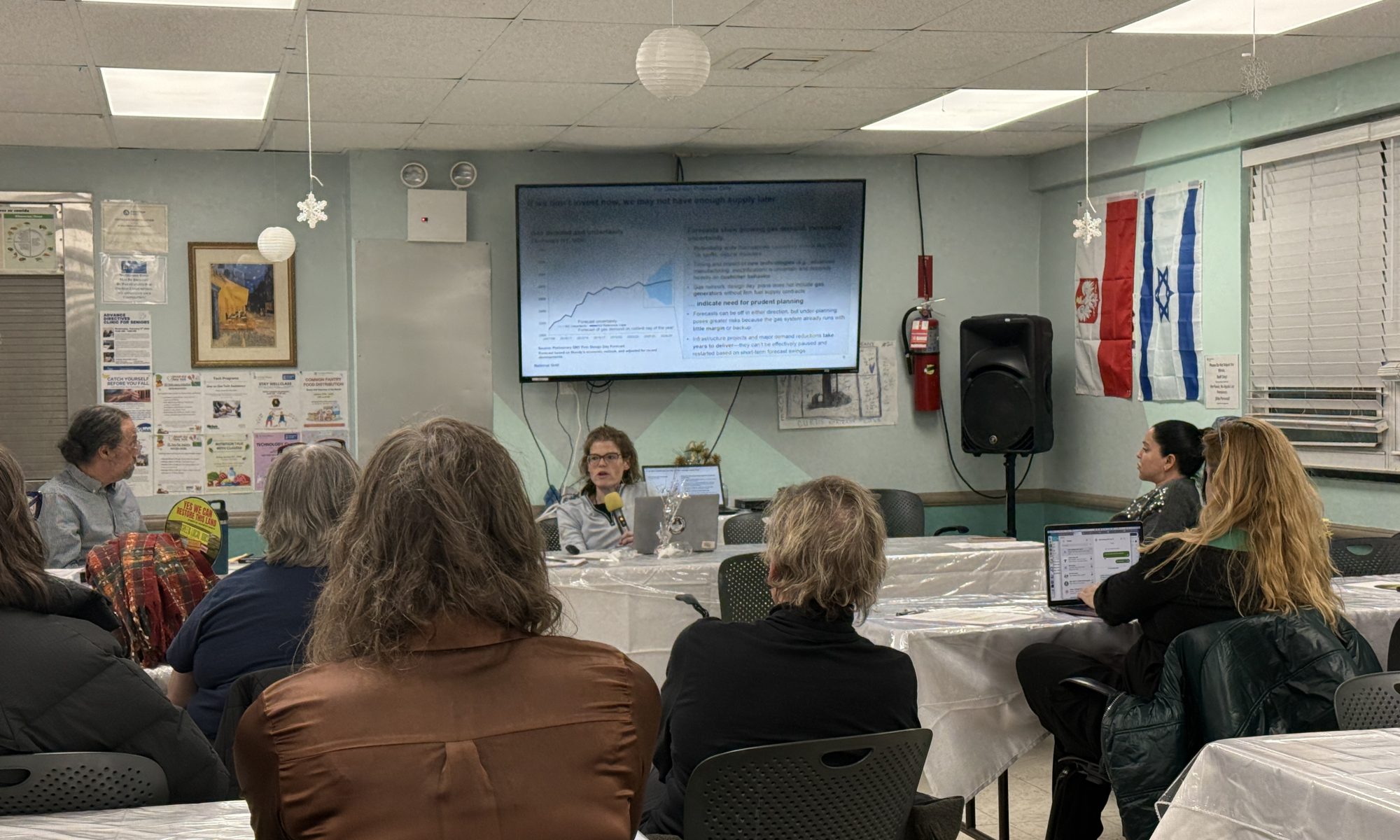
On Thursday, January 15, representatives for National Grid — which provides energy to nearly 2 million customers in the New York metro area — met with Brooklyn Community Board 1 (CB1) at Swinging Sixties Older Adult Center, the first in-person forum since the state approved the company’s request to expand its fracked gas infrastructure last fall.
But this wasn’t a victory lap. While the approval of its “Long-Term Plan” was a major coup for National Grid, the regulator’s decision included some caveats. First, it noted that a new pipeline project running from New Jersey to the Rockaways, known as NESE, could eventually render National Grid’s 120-acre gas depot along Newtown Creek unnecessary, a boost to locals who have been calling for it to be decommissioned for decades.
Second, the ruling ordered National Grid to engage with CB1 and “take part in its meetings,” as a way for the fossil fuel giant to “hear the community’s concerns and attempt to address [them].”
The exact parameters or duration of that engagement are unclear, but the upshot on Thursday was clear: National Grid’s emissaries would have to answer questions from residents who have spent thousands of hours trying to shut down its primary foothold in North Brooklyn.
The meeting began with a presentation by MaryBeth Carroll, director of gas scenario planning for National Grid and a lead architect of its Long-Term Plan, who foregrounded the discussion with an overview of the company’s operations throughout New York City. Nearly all of its fracked gas is sourced from the Marcellus Shale in Northern Pennsylvania, she explained, before being carried by pipelines to two storage facilities — one in Holtsville, Long Island, and the other in Greenpoint.
“Do you all acknowledge that Greenpoint residents don’t want this LNG storage in the neighborhood?”
The audience, exclusively composed of local environmental advocates, wasted no time in interrogating Carroll’s high-level summary. One bone of contention during the two-year legal battle over the Long Term Plan was whether the quantity of natural gas stored inside the Greenpoint Energy Center made sense. National Grid claimed that the hulking tanks were a fallback in case the demand for gas spiked far above supply amid an extremely cold spell. But an independent consultant found that those reserves were almost never used — and as one attendee noted, the corporation’s forecasts are based on a hypothetical “design day” in which the average temperature drops to 0º Fahrenheit, something that has not happened in NYC since 1934.
“It has not gotten within 10 degrees of that in the last 15 years,” noted a member of Sane Energy Project, a Greenpoint-based advocacy group that was out in force for the CB1 meeting. “If there’s evidence to show that it should be raised, are you currently working to raise it? Because clearly this is not appropriate design day, and that’s costing all of us who pay bills here a lot of money.”
The presentation next turned to safety protocols. “We want to make sure that everybody who is a customer stays safe, that everybody who is living in the communities around our customers stays safe, and that our employees stay safe,” said Carroll. “It’s just something that we are uncompromising on.”
But the Greenpointers in the crowd shot back with several pointed questions. Kim Fraczek, director of Sane Energy Project, brought up an explosion at the nearby gas depot in 2022 that knocked a worker unconscious, asking why the community board was never informed. (“I’m aware of that incident,” replied Carroll, promising to loop in CB1’s Steve Chesler in the future. “I don’t know the details.”)
Next, Laura Hoffman inquired about the extent of soil pollution at both depot site and an adjacent Little League field that was opened by National Grid in 1999 as a gift to the community before being closed in 2022 as revelations of contamination came to light. “To my knowledge, the lead that was on the property from previous demolitions was never cleaned up, which was part of the reason why the kids were no longer allowed to use the ball field,” she said. “My grandson was one of the kids that played there. Since you’re talking about the commitment to safety, I want to hear about that.”
Another prominent topic was National Grid’s initiatives to promote non-pipeline alternatives (NPA), a range of measures — such as heat pumps, improved insulation, and managing demand — that limit the need for companies to build more gas infrastructure. Residents noted that National Grid refers many customers to Con Edison’s program rather than investing in one of its own.
“We would be very interested to work with you on that. If you’re considering doing pipe replacements, you can work together with us from the community to organize blocks to do that,” said Fraczek. “The last time you had a community engagement person come to CB1, he told me and a few others that the only thing he does with his job is tell people when to move their cars. I wonder if there could be a better partnership.”
“We’re happy to do it,” said Carroll. “We want to deliver on these things, we just need willing customers.”
The final word, before the National Grid contingent ceded the floor to a representative of an organization working to abolish microplastics, went to fourth-generation local Kevin LaCherra, who refocused the conversation on the Greenpoint Energy Center.
“This community does not want this facility here. It is on some of the most polluted land in North America. It’s 120 acres — you could fit every park in the neighborhood on that facility,” he said. “We’re asked to subsidize it; we’re asked to live next to it. So I do think, with all of this, what I really want to know is do you all acknowledge that Greenpoint residents don’t want this LNG storage in the neighborhood?”
“What I am most interested in going forward is how your planning, as you come back here, is going to reflect what we as residents are asking for,” added LaCherra. “That needs to be a part of this going forward — otherwise, it’s a lot of fancy slides.”