A proposal to build towers by Bushwick Inlet has drawn pushback, and a key hearing is next week. Here’s what you need to know.
By COLE SINANIAN
news@queensledger.com
On Tuesday, January 20, Greenpointers will testify to Community Board 1 regarding plans from the Gotham Organization to build three residential towers just to the north of Bushwick Inlet, marking the beginning of what is sure to be one of Greenpoint’s landmark land-use battles of the year.
The proposed development, located at 40 and 56 Quay Street on a small peninsula called Monitor Point, would also include museum and retail space and require a rezoning from medium to high-density. It has garnered serious opposition from local activists, who argue the towers are far too big for the location and betray a two-decade-old commitment on the City’s part to reserve the area around the inlet for public parks.
There are also environmental and gentrification concerns; the towers would sit on the banks of a rare and ecologically sensitive estuary that’s only just begun to recover from centuries of environmental exploitation. And with nearly 3,000 new residents expected to be added to the neighborhood — most of whom would be paying luxury rent — critics worry that the project will only accelerate displacement in an already gentrified community.
Developers and City planners, meanwhile, have highlighted the importance of boosting housing stock and the public benefits the project would fund. Namely, a new Greenpoint Monitor Museum — which would explore the history of the USS Monitor, an early ironclad ship built in Greenpoint — and an extension of the East River esplanade that would connect the Greenpoint and Williamsburg waterfronts.
But the land on which the proposed towers would be built — currently owned by the NYC Transit Authority and the Greenpoint Monitor Museum — was set aside as park land as part of the 2005 Greenpoint/Williamsburg rezoning, with the intention of eventual acquisition by the City Parks Department. For the local critics, at issue is the question of the role the public should play in deciding the fate of New York City’s treasured waterfront land, and the City’s responsibility in honoring the word of former administrations.
“There’s this choice that’s being presented to us that’s not fair or feasible,” said Katherine Thompson, one of the directors at Friends of Bushwick Inlet Park, at a January 8 presentation at the Greenpoint Library. “That you can have either open space and protect the environment or affordable housing— it shouldn’t be this dichotomy.”
The Plan
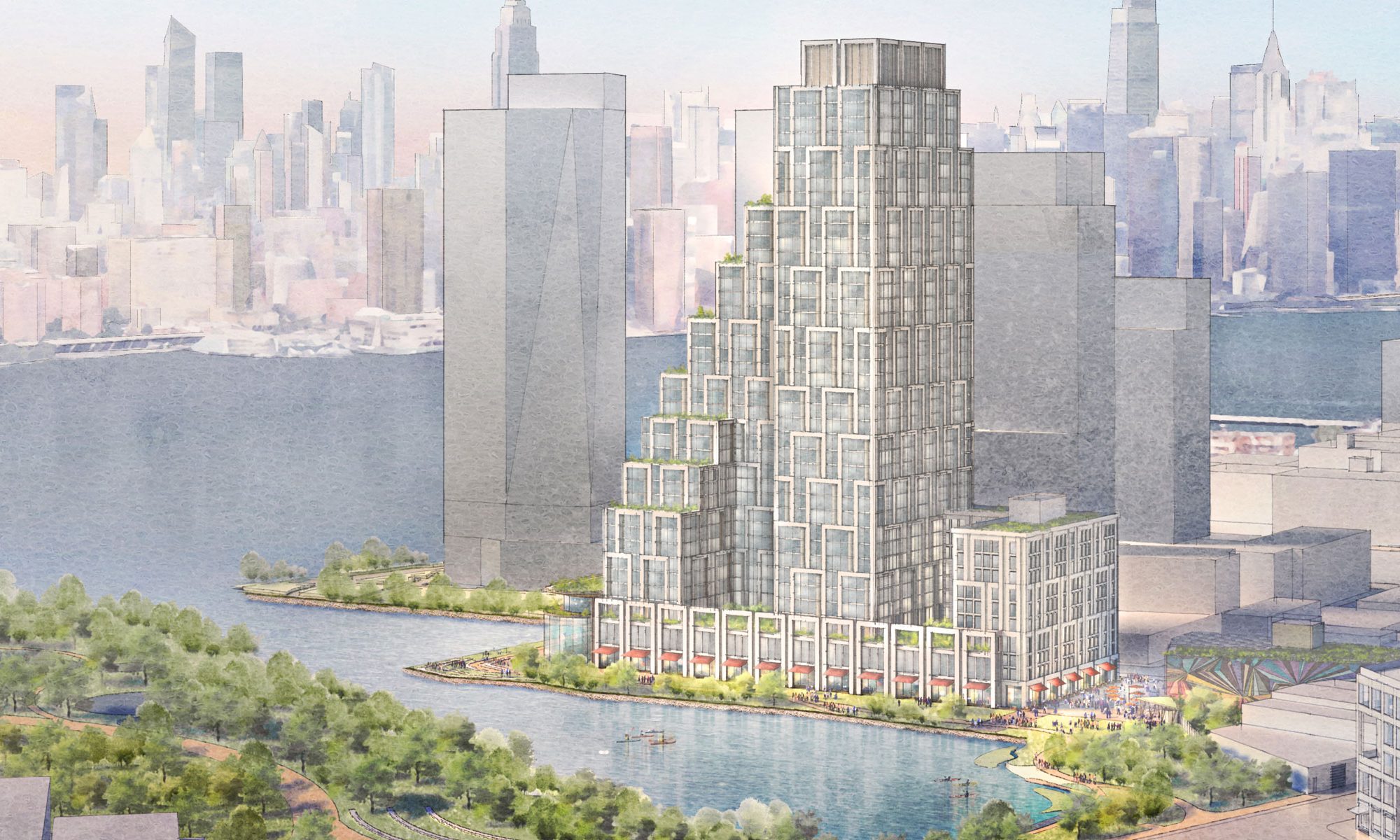
The mixed-use development would include three residential buildings, pedestrian connections along the waterfront that would connect Bushwick Inlet Park to the Shore Public Walkway to the north, retail space, and a building that would house an expanded Greenpoint Monitor Museum. The residential towers would stand 640ft tall, 490ft and 260ft tall and sit about 50ft from the Bushwick Inlet shoreline. The two properties, 40 Quay Street and 56 Quay Street, currently house an MTA storage facility and the current Monitor Museum, respectively.
The developers would need a rezoning to build towers of this scale. Currently, the area is zoned R6, which is medium density and requires developers to implement setbacks and other contextual considerations when building towers. They are seeking to upzone to R8, or “high density” residential.
The Gotham Organization estimates construction cost of $630 million. Altogether the towers will include 1,150 residential units.
The Opposition
As part of the consequential 2005 Williamsburg/Greenpoint rezoning that transformed the heavily polluted, once-industrial area into residential neighborhoods, the City set aside several plots of land around Bushwick Inlet to be converted into public park space. Monitor Point was one of these properties, designated as park land on the City Map. Another became the current Bushwick Inlet Park. Others have remained empty, the soil contaminated from years of housing petroleum and fuel storage facilities, still awaiting cleanup.
Friends of Bushwick Inlet Park was formed in part to hold the City accountable for ensuring this land became the public space that the rezoning designated it as, said Greenpointer Steve Chesler, who sits on the organization’s board of directors. In 2015, a paper storage facility owned by CitiStorage caught fire and burned to the ground. The City considered allowing the property owner to sell it to a private developer, but Friends of Bushwick Inlet launched an aggressive campaign, urging the City to purchase the property and keep its commitment to making this land available to the public.
For Chesler and Thompson, the move to build residential towers on a property once slated as park land represents a betrayal by the City, and an insult to years of activism aimed at preserving the waterfront around Bushwick Inlet for.
A petition by a group called Save the Inlet has already gathered more than 5,000 signatures. At the January 8 meeting at Greenpoint Library — organized to educate Greenpointers and to help them prepare their testimonies for the hearing on the 20th — community members expressed concern about the neighborhood’s population density, the shadows the towers would cast, the traffic construction could cause, and the use of small affordable housing concessions to justify what they have described as an unsustainable and out-of-context development.
Scot Fraser, a documentary filmmaker who sits on Friends of Bushwick Inlet Park’s Board of Directors, called out the long shadows the towers would cast over the adjacent neighborhood. He also pointed out the irony of the situation — the northernmost section of the park, known as the Motiva Parcel, is set to open in the coming months after years of cleanup and advocacy. However, should the Monitor Point Towers be built, the Motiva section’s opening will likely coincide with the noisy arrival of cement trucks and construction crews.
“That part of the park is just about to open, the Motiva section of the park, will be immediately devoured by excavating trucks,” Fraser said.
Some residents at the meeting called the city’s affordable housing designations out-of-touch. According to the Draft Impact Environmental study, the Gotham Organization will make 25% of the Monitor Point towers’ residential units affordable at 60% area median income (AMI), a salary that, in New York City, amounts to about $87,000 for a three-person family.
Others, meanwhile, criticized the City for making the discussion about housing at all.
“They love the idea about us spending time talking about what percentage of affordable housing, because then they’ve already forced the false choice,” said a Greenpointer named Andy.
“We don’t want to talk about what percentage of affordable housing. We want to talk about, find another site.”
The Process
Despite the already simmering opposition, the plan is still in the earliest advisory stages of the city’s Uniform Land Use Review Procedure, or ULURP, which dictates the approval process for development.
ULURP goes like this: A developer submits its plan, along with a draft environmental impact statement, to the Department of City Planning, which reviews and certifies it. Next, the local Community Board has 60 days to review the application and provide a recommendation. This recommendation is non-binding.
“It’s not technically binding conditions,” said Chesler, who also sits on Community Board 1. “But the board kind of sets the stage. The borough president, and especially our city council member, have to answer to the people.”
The community board review stage is made up of several meetings, of which the public hearing on January 20 is a part. On February 3, the Community Board’s Land Use Review Committee will meet to deliberate, followed by a full-board vote on February 10.
After the community board’s recommendation, the plan goes to the borough president, whose recommendation will take into account the community board’s. Still, the borough president’s recommendation, like the community board’s, is non-binding, meaning the plan could still proceed without it.
The plans are then sent to the City Planning Commission (CPC) for a 60-day review. This decision is binding; the plan dies if the CPC rejects it.
If the plan is approved by the CPC, it then goes to the City Council for a 50-day review. “Member deference” is customary— that is, the City councilmember whose district the plans concern has the final say. In this case, that councilmember is Lincoln Restler.
Finally, the mayor has the option to veto the council’s approval. If he does not, then the project is approved.
The January 20th public hearing begins at 6:00pm in the auditorium of the Polish and Slavic Center at 176 Java St. The public will get one minute to read their testimonies. It might make sense to arrive early— if the January 8 meeting was any indication, the hearing on the 20th will be quite the spectacle.