By Adeline Daab | news@queensledger.com
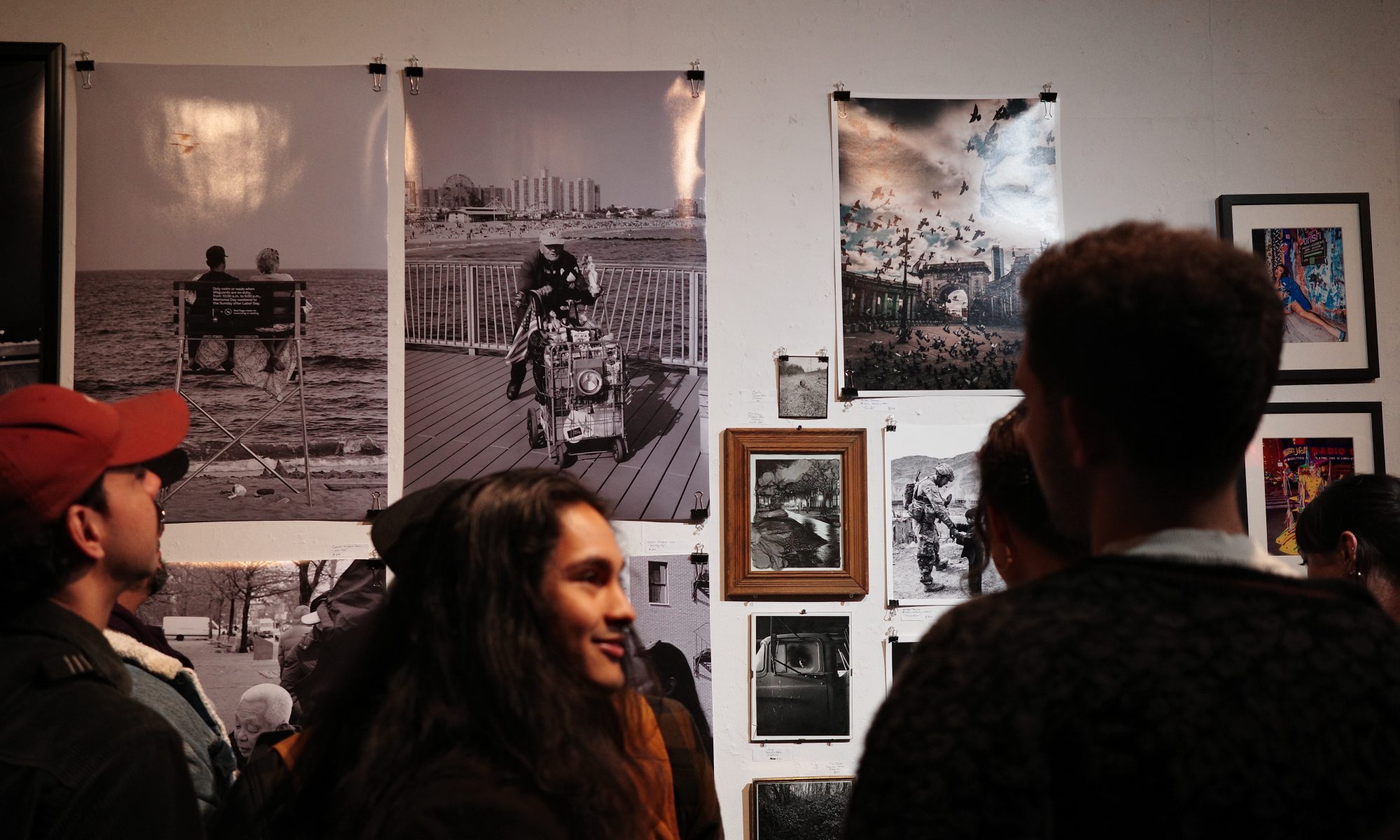
On the final Friday evening of February, Greenpointers and visitors alike sought inspiration, intrigue, and evocative conversation at Greenpoint Gallery’s Photos Only Salon Show.
Curated through an open call for submissions, this semi-regular show gives emerging photographers a rare opportunity to publicly celebrate their work in a city known for an impenetrable arts scene. Once-blank walls were transformed into mosaics of prints in an expansive range of styles, sizes, color schemes, moods, and themes. Subjects of the featured photos oscillated from a curious orange bird titled “Andean cock-on-a-rock,” to swerving skid marks on an empty country road titled “Past Mistakes.” A striking set of silver gelatin prints of a college campus, processed using the Mordançage technique, depicted dissolving shadows flowing beyond the frame in billowy veils of ink.
The crowd was as eclectic as the photos: a blend of artists, art-appreciators, and people just looking for something to do on a Friday night. Everyone I approached was eager to converse, including (or perhaps, especially) the photographers behind the photos showcased that evening. I struck up a conversation with a woman who turned out to be the photographer behind a featured collage series of New York City subjects superimposed onto calming rural scenes. The idea for this series emerged from her experience of splitting time between NYC and a rural North Carolina property she acquired through a saga involving a cheap Craigslist car, a golden Ganesha statue, a five-leaf clover, and an unwavering belief in signs from the universe. I also spoke with Tashroom Ahsan, the up-and-coming photographer behind the aforementioned Mordançage works. “I’ve been at this show before as a witness,” he said, “but there’s something remarkable about being a participant. Lending physical presence to my work and seeing others engage with it has given it a life I’d never seen before.”
Many attendees were artists in mediums other than photography. In a pond of twenty- and thirty-somethings, the grey-haired painter Julie effortlessly matched the lively, youthful energy buzzing in the space. She was glad to see emerging artists getting the chance to gain visibility and feedback on their work, reminiscing about how the early days of her practice have shaped the way her artwork looks today. When she was young, she couldn’t afford frames for her paintings so she began a practice of painting artistic borders around her work. Decades have passed. Her frames have grown ever thicker around the page, swallowing more and more of the space available for a central image.

Now her paintings are almost entirely about the frame rather than what fills it. As Julie observed Friday night’s photographs, she pondered the three components of any work of art: the artist, the material, and the unknown. Looking for the element of the unknown within the displayed works framed my experience of the photographs for the remainder of the evening.
I was a few stairs up the flight to the gallery’s upper level when I peered over the railing. A gargantuan stuffed frog stopped me in my tracks. I asked the man standing beside it if he knew what it was for, and he told me he’d made it for a children’s puppet show. Somewhere in the midst of this conversation, he subtly revealed that he was the visionary behind the space, and Shawn James went on to humor all of my subsequent curiosities about the gallery’s origin and evolution.
He shared that this was all possible because John Perry Barlow—whom he identified as “the guy who wrote most of the songs for the Grateful Dead”—bought one of his early paintings for $25K. Gesturing to the painting on the wall beside us, James told me that Barlow had shipped it back to him from his deathbed, along with a note saying James could probably get $50K for it now. Barlow had become a mentor for James throughout his later years. When James asked how he could repay Barlow for everything he’d done to support him, Barlow told James to be to other young artists what Barlow had been to him. From this, Greenpoint Gallery’s mission was born in 2003: to empower emerging artists through classes, lectures, career counseling, and affordable exhibition space.
At the gallery’s information booth, a multi-medium artist currently interning at Greenpoint Gallery expanded on the gallery’s program offerings, including shows and lessons across a variety of popular mediums, communal studio space, and even an artist residency program. The gallery is also always looking for more interns—an invaluable opportunity to learn what happens behind the scenes in gallery spaces and build up experience in the New York art world.